

The later living sector has spent years on the periphery of mainstream property development, but this is shifting rapidly.
Demographic pressure, evolving attitudes to retirement, and a growing supply shortfall are drawing significant attention from developers, investors, and institutions to a sector that has, for too long, been underestimated.
The supply gap is real — and growing
The UK’s over-65 population is projected to reach 17 million by 2040, yet specialist housing for older people represents just 0.6% of the total housing stock. By comparison, the US and Australia sit at around 5-6%.
The undersupply isn’t just a housing challenge; it has a material knock-on effect across the wider property market. Every older person who moves into appropriate later living accommodation frees up a family home. According to research from Savills and Knight Frank, each later living unit delivered releases an average of between 1.1 and 1.5 existing properties back into the market. The sector’s potential contribution to the broader housing supply problem is increasingly part of the planning and policy conversation.
A sector still finding its identity
The later living sector has been historically challenging to define in its nature, with multiple offerings falling under a broad label. Integrated retirement communities (IRCs), age-exclusive housing, extra care, assisted living, and care homes all occupy the same space but serve meaningfully different needs, and carry vastly different development and operational profiles.
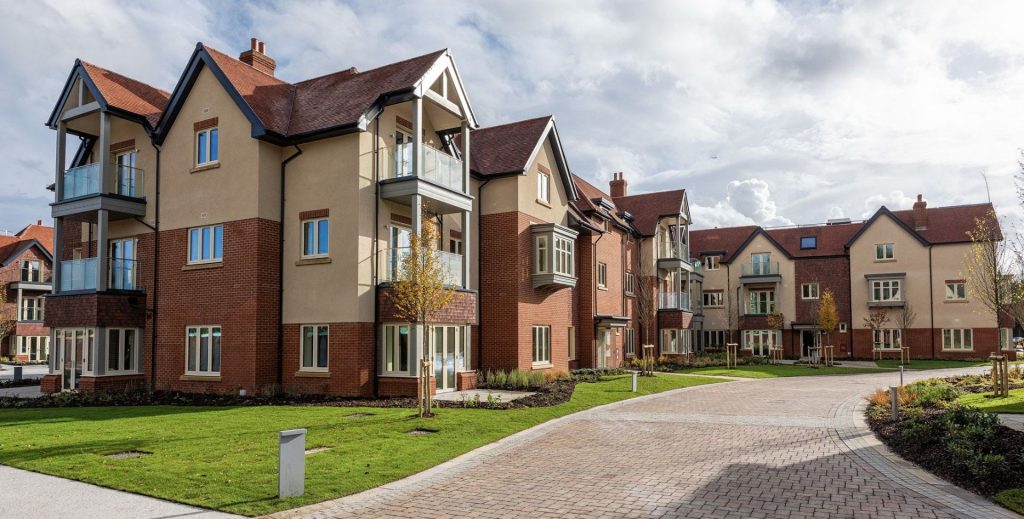
The emergence of the IRC model in particular, purpose-built communities offering independent living alongside care provision, on-site amenities, and a hospitality-led experience, has repositioned what later living can look like. Major operators including Inspired Villages, Legal & General, and Audley Group have raised the bar significantly in recent years, with schemes that would not look out of place in high-end residential or boutique hotel development.
This evolution has practical implications for project delivery. These are complex, multi-phase schemes that often require close co-ordination between developer, operator, care provider, and planning authority. The procurement routes, programme management, and contract structures involved are strategically different from a standard residential or commercial project.

Build costs and viability
Later living schemes, particularly IRCs, carry a higher specification than standard residential developments, with requirements around accessibility, communal space, care infrastructure, and amenity that push build costs meaningfully above those of comparable residential schemes.
Current build cost benchmarks for quality Later Living development typically sit in the range of £2,500 to £3,500 per sq m, depending on specification, location and procurement route, though premium schemes can exceed this. Against a backdrop of sustained cost inflation, labour market pressure, and a supply chain that is still recalibrating post-pandemic, managing those costs through design development, procurement and on-site delivery requires careful, experienced handling.
There is also the question of scheme viability. The sales and tenure model for later living differs from mainstream residential; deferred management charges, event fees, and leasehold structures all have implications for GDV and appraisal, and the funding landscape (particularly for affordable or social rent later living) continues to evolve.
Complexity with M&E
M&E specification is a challenging area for later living. These are not standard residential buildings. The combination of care infrastructure, accessibility requirements, life safety systems, communal facilities, and increasingly stringent energy performance standards means that M&E is a significant cost and programme driver, typically representing 20–30% of total construction cost on an IRC.
Warden call and telecare systems, fire detection zoned for assisted evacuation, integrated access control, emergency power provision, and building management systems capable of real-time ESG reporting all need to be co-ordinated from the earliest design stages. The UK’s transition to a fully digital communications network by 2027 adds a further layer of complexity for operators of existing schemes and a design consideration for new ones.
On the decarbonisation side, the trajectory toward the Future Homes Standard points clearly to heat pumps and low-carbon heat networks replacing gas in new residential development. For later living, communal heat networks can be an efficient solution, but require careful specification, commissioning, and long-term maintenance planning to deliver the comfort levels that residents require and that operators depend on.
Getting M&E right early is one of the most important contributions a project manager and building surveyor can make on a later living scheme.
Planning for long-term viability
One aspect of later living that is often overlooked in development conversations, but which shapes the long-term success of a scheme, is planned preventative maintenance (PPM).
For an IRC operator, the building is not just a product that gets handed over at practical completion; it is an ongoing, inhabited environment where the fabric, plant, and systems need to function reliably, every day, for residents who are often more dependent on building performance than occupants of any other asset class. A lift failure is not an inconvenience in a later living scheme, it can be a safeguarding issue, a heating system breakdown has genuine welfare implications, a failing warden call system creates regulatory exposure.
This places a premium on thorough PPM planning from the outset. At HartDixon, we are currently developing PPM instructions specifically tailored to the later living sector, drawing on our building surveying expertise to create maintenance schedules that reflect the unique performance demands of IRC assets. A well-structured PPM programme for a later living scheme needs to address:
- Building fabric — external envelope, roofing, drainage, and communal areas, all of which face heavier wear and more complex inspection regimes than standard residential
- M&E plant and systems — heating, ventilation, lifts, warden call, fire detection, access control and emergency power, each with specific statutory inspection and servicing requirements
- Communal and amenity spaces — commercial kitchens, wellness facilities, pools, and landscaped areas, which carry their own compliance and maintenance obligations
- Regulatory compliance — fire safety, Legionella management, lift inspection, electrical testing, and increasingly, EPC and energy performance reporting for institutional investors
The funding model for later living, where service charges, event fees, and management agreements govern the operator’s income, makes cost certainty in PPM particularly important. Poorly specified or deferred maintenance creates liability, reduces asset value, and most critically undermines resident confidence.

ESG and the investment lens
Institutional investment in later living has accelerated significantly. The sector now attracts capital from major insurers, pension funds, and real estate investment vehicles who see later living as a long-duration, needs-driven asset class with strong ESG credentials.
That investment lens brings its own pressures around sustainability, design quality, and operational standards. The expectation of embodied carbon reporting, energy performance, and whole-life cost analysis is increasingly standard for institutional-grade schemes, and the diligence requirements that come with that investment are more rigorous than the sector has historically been accustomed to.
A challenging, yet rewarding sector
The later living sector presents a compelling opportunity, but it is not a simple one. The schemes are complex, the stakeholder landscape is broad, and the standards expected across design, sustainability, and delivery are high and rising.
That is, in many ways, precisely where HartDixon operates best. Our experience in technically demanding, multi-stakeholder projects — whether in commercial refurbishment, data centre delivery, or occupier fit-out — translates directly into the kind of careful, expert project management and building surveying that later living schemes demand.
If you are active in the later living sector, as a developer, investor, operator, or landowner, and would like to explore how HartDixon can support your projects, we would be very glad to hear from you.